What is the future of gigabit internet?
18. 11. 2020
Thankfully, the days of slow and expensive dial-up connections are long gone. Lately it may seem rather that there are more and more ways to connect to the internet quickly and cheaply. Among other things, the term "gigabit internet" keeps coming up. What does it mean, who is it suitable for, and how is its roll-out going?
Gigabits over cable
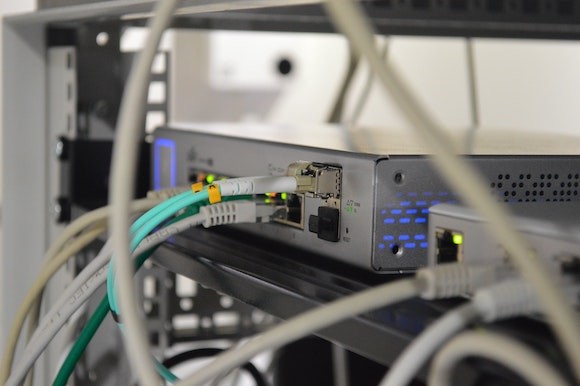
Gigabit transmissions are data transfers at speeds above one gigabit per second. Transfers at such volumes can run over cable: the IEEE 802.3z and 802.3ab standards were the first to define them, and data is transported either over a metallic cable with four pairs of twisted wires, or over optical fibre. Gigabit Ethernet is sometimes abbreviated to GbE or 1 GigE.
Ethernet was for many years the most widely used technology for data transfer, but at first its speeds were not really dizzying (it met the requirements of distribution networks, especially wiring inside buildings). The speed of traditional Ethernet was 10 Mbps, while Fast Ethernet could reach up to 100 Mbps. Gigabit Ethernet was initially intended for university networks, government organisations or large IT companies, but at the start of the new millennium it gradually made its way to ordinary consumers as well. Among the first mass-sold computers with Gigabit Ethernet support were Apple's Power Mac G4 and PowerBook G4, and over time it spread to most commonly sold personal computers.
Gigabits over air and optical fibre
Gigabit data transmission can, of course, also travel wirelessly. For the type of wireless communication whose transmission speed reaches or exceeds 1 Gbps, the designation Gigabit Wireless is used. These speeds are achieved with the help of complex signal modulation, such as quadrature amplitude modulation (QAM). In the communications industry, many internet providers use different systems for transmitting data in different frequency bands, one of which is similar to the frequencies used by WiFi routers. Wireless communication is used everywhere from the outputs of optical networks for distributing data over professional links, to smaller municipalities, and also to connect businesses and individual residential buildings. As the capabilities and performance of technologies grow, so do the demands on internet connection speed, so providers are increasingly looking for ways to extend gigabit services to ordinary customers too. The solution may lie in building a reliable optical infrastructure.
Gigabit Czechia
A gigabit speed for home internet connections is certainly not an impossible dream. A number of domestic providers already offer speeds in three-digit figures, and many of them see a great future in the optical connection already mentioned. Paradoxically, building optical networks is easier in smaller towns and municipalities, where settlement is less dense and construction is easier, and where the physical conditions for building optical networks are somewhat lighter than in densely populated centres. Against this stand the very high financial cost of investment and a very long payback period. That is why, in certain types of agglomeration, we need to count on a combination of optical cables and wireless means of data transmission.
However, building a "gigabit Czechia" – a society in which the basic, widely available connection technologies offer gigabit bandwidth – requires the cooperation of many participants, from residents of towns and municipalities, through internet providers and local governments, all the way to ministries, the government and legislators. The Ministry of Industry and Trade has drawn up the Action Plan 2.0 to speed up the construction of high-speed networks, and the National Plan for the Development of Next Generation Networks. A number of associations, institutions and individual experts are also campaigning to speed up the development of high-speed networks. But building optical networks does not face only organisational obstacles. There are also a number of barriers connected with excavation work, and another significant component is the fees for placing networks on the land of municipalities and the state, which are often higher than the construction itself. Despite the theoretically low demands, many municipalities still lack the necessary ICT infrastructure. A sophisticated and reliable optical infrastructure is important not only for gigabit internet "above and below ground" (the original "po(d)zemní" is a play on words), but is also an important element in building 5G networks, from which in the future not only organisations and institutions but also individual towns and municipalities may benefit. You can read more about 5G networks here. A major help for gigabit Czechia was also the release of the 60 GHz band.
If you enjoy high-quality connections and similar topics, you should also read the previous article Optical fibres are safe.
Updated 20 March 2024