Optical fibres are safe
26. 10. 2020
Topics concerning the effects of various telecommunications network technologies on the health of residents, or rather of users of telecom services, are certainly an important part of public debate. It is also important to talk about how different technologies affect one another, for example the mutual interference of some channels of the LTE mobile network and digital television broadcasting.
Recently, however, questions have also been raised about possible effects of optical networks. So let us summarise what such an optical network installed in an apartment building actually is, and what technologies are used in it.
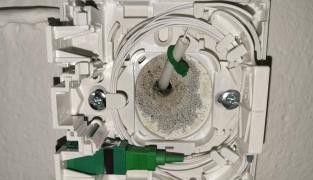
Optical fibre split off from a multicore riser cable, or separate optical cables run in an appropriate protective sheath, are used to connect individual apartment units. The designer of the solution decides based on the number of flats and the spatial layout of the apartment building. In both cases, all the fibres are routed to a central technical room, which serves as the basic distribution point.
What exactly is an optical fibre?
An optical fibre is a cylindrical dielectric waveguide in which electromagnetic waves (usually light or infrared radiation) propagate along the axis of the fibre, using the principle of total internal reflection at the boundary of two media with different refractive indices. The inner part of the fibre is called the core; around the core is the cladding and primary protection. Each fibre can carry many independent signals, each using a different wavelength of light. Building short-distance networks with optical cables, such as within a building, saves space in cable routing, because a single fibre can carry far more data than one electrical cable. The fibre is also immune to electrical interference. Optical cables are not electrically conductive, which makes them a good solution for protecting communication equipment installed on high-voltage transmission lines and on metal structures susceptible to lightning strikes. They can also be used in environments where explosive vapours are present, without the risk of ignition, or where there are concerns about mutual interference with metallic cable lines. As a light signal passes through the optical medium, no electromagnetic field is generated that could affect signals in other conductors. With a glass fibre you can communicate in close proximity to 400 kV extra-high-voltage (ZVN) power lines.

The active part of communication in optical cables is handled by precise laser modules. These modulate information from electrical signals into light signals. At the opposite end of the optical line, for example in the user's home, there is usually a network terminal device with a similar laser module. Converting the optical signal back into an electrical one, which can be processed, for example, by a home WiFi router, may be handled by a separate device, a so-called media converter.

How safe is the laser source itself?
Czech legislation leaves nothing to chance. We follow the Government Regulation of 12 December 2007 on the protection of health against non-ionising radiation, as amended. The binding technical standards are ČSN EN 60825-1 and ČSN EN 60825-2, Safety of optical fibre communication systems – classification of equipment and requirements for it.
Common laser sources used in optical networks belong to safety class 1. This is the same hazard classification as DVD players or weak laser pointers. Safety class 1 includes equipment that poses no danger to human health, even with long-term exposure.

Installing optical infrastructure indoors therefore poses no danger to residents' health. Thanks to its dielectric nature, it is in fact by far the safest solution in terms of co-location with other utility networks in apartment buildings.

As the classic saying goes: everyone wants fibre.
Read our next article: Benefits of a fibre connection.
Updated 15 April 2024