Virtual reality: a phenomenon of our time
21. 5. 2020
Virtual reality is growing in popularity – and is finally becoming more and more accessible. Its uses go far beyond entertainment. It also holds potential for science and education. What options do users have if they would like to enjoy the virtual world in the comfort of their own home?
How did it begin?
Descriptions of virtual reality date back as far as the last century – in 1968, Ivan Sutherland and his student Bob Sproull built the historically first "headset" at Harvard University. The device had to be attached to the ceiling and displayed a very primitive environment. A significant breakthrough came only in 1977 at the Massachusetts Institute of Technology (MIT), where experts created a program simulating a walk through the streets of Aspen, Colorado. In 1985 Jaron Lanier founded VPL Research, which developed the first "goggles and gloves" systems. It was Lanier who popularised the term "virtual reality".
Gradually, virtual reality found its place mainly in science and research – for example at NASA – and then it also made its way into the gaming industry and into the everyday areas of human life.
Let yourself be absorbed by VR
While augmented reality adds digital elements to the picture of the real world, so that the user never loses at least partial contact with it, virtual reality completely absorbs you and cuts you off entirely from "ordinary" reality.
For perfect isolation from all surrounding noise and perfect immersion in the virtual environment, you need high-quality equipment, both in terms of audio and visual hardware – that is, the headset – and in terms of computer equipment. Until recently, virtual reality – mainly for financial reasons – was the preserve of specialised arcades or companies that used it for research and development, but more and more often virtual reality devices are finding their way into ordinary homes too.
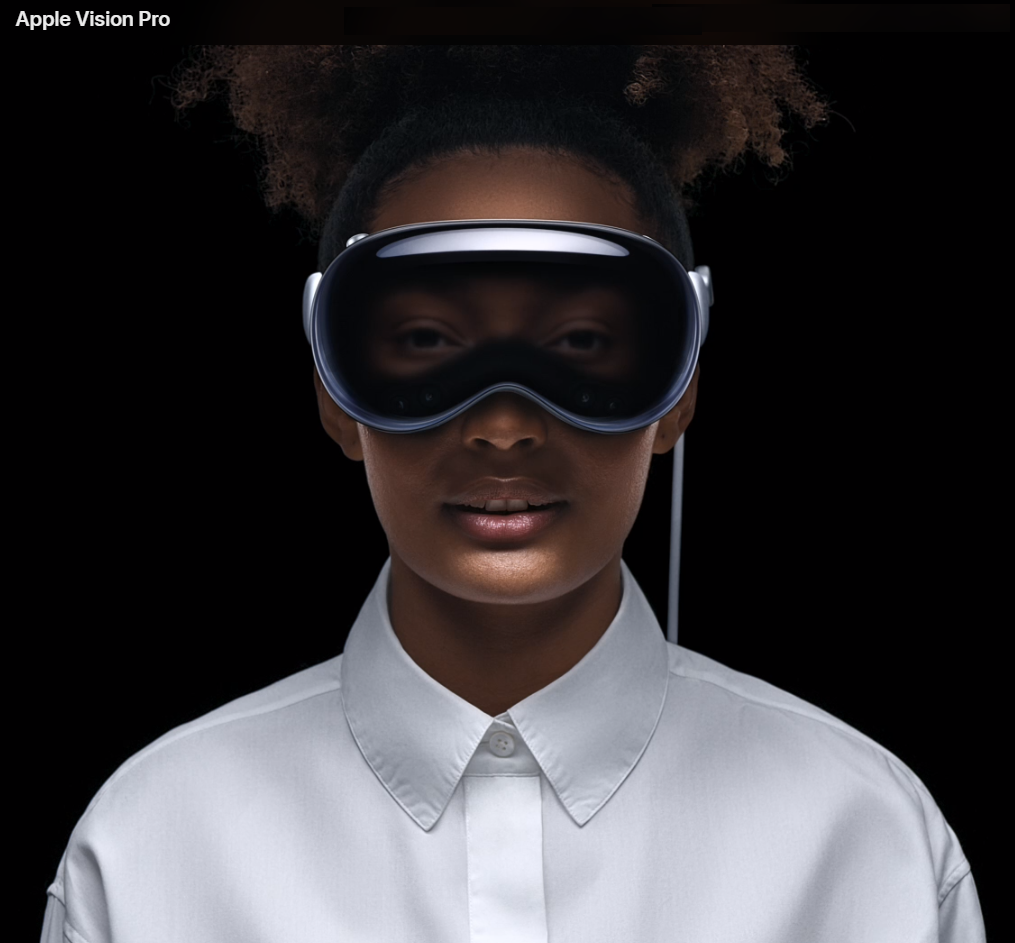
Now we know how effective it can be to use something like the Apple Vision Pro on the go, which Apple launched in early February 2024. You can also read our article Office on the go. Mobile apps that make your work more efficient and save you time..
Augmented or virtual?
Many people confuse virtual reality with augmented reality. The main difference between the two technologies lies in the way digital information is displayed. With augmented reality (AR), the name itself suggests that the image of the real world is extended with digital content. By contrast, virtual reality uses two displays to create a 100% illusion, in which the user perceives the virtual environment as real.
An example of augmented reality use is the popular game Pokémon GO. AR can also be used when planning interiors, in popular science applications, and in science and industry.
You can view augmented reality not only on the screens of your smart mobile devices, but also through special glasses offered by companies such as Microsoft (HoloLens glasses), Acer (Acer Mixed Reality Headset) or Google (Google Glass)
A console, a computer, or a box for your phone?
When people say "virtual reality device", most think of names such as Oculus Rift, Gear VR or HTC Vive. The HTC Vive could, with a little exaggeration, be described as a "plug and play" device. Playing games does not require any special software – you simply connect the headset to a computer that meets the relevant requirements.
For a perfect spatial experience, the key step is mapping the room with Lighthouse sensors, which help determine the player's exact position in the space. The HTC Vive also comes with a gradually expanding range of controllers and other accessories, which are designed to improve the experience of play even further. Another giant in the field of virtual reality is Oculus Rift. It boasts, for example, an OLED panel with a resolution of 2160 x 1200 pixels, good-quality built-in speakers and a motion sensor.
For VR headsets that connect to a computer, technical requirements can be a considerable problem. The basic Oculus Rift model requires at least a computer with an Intel Core i5-4590 processor, 8 GB of RAM and an NVIDIA GTX 970 graphics card; similar requirements apply to the HTC Vive.
The huge surprise last year was the PSVR headset from Sony for the PlayStation 4 and Pro consoles. Although a considerable part of the expert public had viewed it rather sceptically before its launch, the PSVR system enjoyed unprecedented success and its sales broke records. It logically follows that PSVR will mainly appeal to gamers, and at present a number of very attractive titles are coming out for this platform.
Cardboard glasses form a separate chapter, where the only requirement is a sufficiently powerful smartphone with a gyroscope and accelerometer. The range on offer is really wide and includes both large manufacturers – from Google through Samsung to Xiaomi – and practically unknown names.
VR glasses for mobile phones range widely in price, from hundreds to thousands of CZK. The cheaper ones are mainly used for passive video viewing (YouTube offers more and more 360° videos on all kinds of topics), while more advanced models also have simple controllers. The difference in price between individual models is also reflected in comfort, battery life and durability of the headset.
Requirements and uses
Technological demands and possibilities: display and interaction in virtual reality
Display and interaction within virtual reality present a challenge compared with the usual monitor environment. Given the curvature of the screen and the specific way virtual reality is perceived, it is key to take into account values such as Field of View (FoV) and Pixels Per Degree (PPD). A much higher resolution is required, which affects not only the display itself but also the volume of data.
Diverse uses of virtual reality: from the gaming industry to scientific applications
Virtual reality offers a wide range of possible uses, from entertainment in the gaming industry to training soldiers or pilots. In medicine it is used for simulating operations and teaching anatomy, while in marketing companies use it to improve promotion and interaction with clients.
Diverse Virtual Reality Applications: From Art to Sport and Work
Virtual reality applications cover a wide range of users' interests and needs. From artistic experiences through to travel and education, they give users the opportunity to explore the world and experience new things. Virtual reality is also making its way into the workplace, enabling designers to work with visualisation tools and providing platforms for watching sporting events or for teamwork.
The future of virtual reality
Just a few years ago, virtual reality was still more of a science-fiction concept for the general public. At the present moment, however, it is slowly becoming commonplace not only to play games in virtual reality, but also to use it in research, development and industry.
Last year, the world's largest manufacturers joined together in an alliance called the Global Virtual Reality Association (GVRA), whose task is, among other things, to spread virtual reality, unify industry standards and develop it together.
However, in 2024 Apple came up with a breakthrough product, a revolution in virtual reality!
Updated 16 February 2024