Bluetooth 5.0 – what it can do and how to make the most of its advantages?
1. 12. 2020
A bit of history
To start, let us recap that Bluetooth is the name of a wireless technology used for transferring data between fixed and mobile devices over short distances, thanks to UHF (ultra high frequency) radio waves – short waves used for television broadcasting, mobile phones, GPS, walkie-talkies and the like. These waves operate at frequencies of 0.3–3 GHz. The protocol works in the unlicensed ISM band at frequencies of 2.402–2.480 GHz. To avoid interference with other protocols that use a frequency of 2.45 GHz, the Bluetooth protocol divides the band into 78 channels (each 1 MHz wide), and it changes channels up to 1,600 times per second.
TIP: Do you like history? Read our article When the internet started in the Czech Republic.
The management, development and improvement of this standard is the responsibility of the Bluetooth Special Interest Group (SIG), which currently counts tens of thousands of member organisations from the fields of telecommunications, computing and consumer electronics. The beginnings of this technology go back to the late 1980s, and Nils Rydbeck of Ericsson Mobile in Lund, Sweden, was one of those behind it. The technology was originally meant to be used in wireless headsets, but over time it found its way into telecommunications and computing. The first "consumer" Bluetooth device was a hands-free headset in 1999, and the first mobile phone with this technology was the Ericsson T36.

Bluetooth 5
In December 2016, the SIG released Bluetooth 5. It was designed to find its use, among other things, in the constantly expanding field of the internet of things (IoT). Among the first companies to bring Bluetooth 5 into practice in devices for ordinary consumers was Sony. At the Mobile World Congress in 2017 it presented its Xperia ZX Premium smartphone with support for this protocol. Bluetooth 5 offers a considerably higher transfer rate than its predecessors – over short distances it can theoretically reach speeds of up to 2 Mbps. This value is more than enough for transmitting high-quality sound – the data stream for the Audio CD format is always 1,411 kbps, the data stream for MP3 can range from 96 kbps to 320 kbps, and for streaming services such as Spotify it ranges from 96 kbps to 160 kbps. So if you have a good-quality internet connection at home, nothing stops you from listening to music anywhere and at any time.

Its range has also increased, reaching an incredible 200 metres in open spaces and up to 40 metres in enclosed spaces. This greatly increases not only the possibilities for listening to music, but also for controlling and communicating between electronic devices, or between individual elements of a smart home. The lower the transfer rate (which with Bluetooth 5 is still adequate even when it is at its lowest possible value), the longer the distance over which individual devices are able to communicate with each other. Bluetooth 5 also offers higher energy efficiency, so you certainly do not need to worry that a higher transfer rate and greater range will cost you in the form of quickly drained batteries in wireless devices. Do the possibilities of Bluetooth 5 seem almost unrealistically ideal to you? Then we have one more piece of good news – Bluetooth 5 is backward compatible, which in practice means that devices supporting it can communicate without difficulty with devices that offer support for only some of the previous versions of this standard. This does not work the other way round, but even so, quite a lot can be done in this respect.
All-powerful adapters
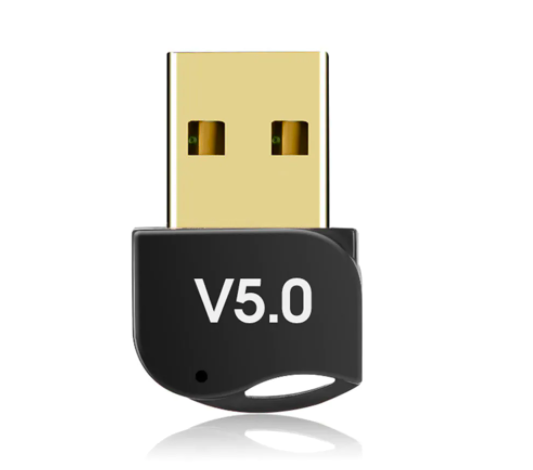
To take advantage of all the benefits of Bluetooth 5, you do not necessarily have to replace all your old devices with new ones that support this protocol. There is a much less costly method – various adapters that give your device support for this protocol. For a few hundred CZK, you can equip computers and other similar products with a USB adapter, which provides not only Bluetooth 5 support but also a longer range, higher transfer rate and significantly lower latency. The vast majority of adapters are "plug and play" devices, which means that in most cases you simply plug them in and do not need to worry about anything else. But USB adapters are not the end of it – Bluetooth adapters can also be equipped with a 3.5 mm jack, a type of adapter used for transmitting audio. You can also get various wireless hubs that receive and send the relevant signal for several devices at once.
Next, I recommend continuing with the article Browsing through time: the history of mobile internet.
Updated 20 March 2024