Will 5G networks cause another wave of COVID-19?
28. 7. 2020
The term “5G networks” has been used in every possible way in recent months, not only in connection with technological progress, faster internet and “brighter tomorrows” for connectivity in municipalities, but unfortunately also in connection with the spread of COVID-19. In many places, petitions are being signed against the installation of 5G transmitters and the launch of networks on a certain frequency, and a number of operators and internet providers have to face the unpleasant consequences of the spread of all kinds of rumours about 5G networks. What is true about them? Should we be panicking?
TIP: Also read our previous article Coronavirus and its impact on technology and digitalisation
What are 5G networks?
First, let us briefly summarise what these 5G networks actually are. As the name suggests, they are wireless systems of the fifth generation of telecommunications standards, which are gradually set to become the direct successor to the existing 4G (LTE Advanced). 5G networks bring benefits in the form of a several-fold increase in transmission speed, a significant reduction in latency between connected devices and the base station compared with older generations of wireless networks, and great potential for various areas of use. Among the first swallows to launch 5G networks for commercial operation last year were South Korea and the United States of America, for example. In Europe, the Italian operator Telecom Italia, for example, has been active in rolling out 5G networks, and in Germany it was Deutsche Telekom. But we are also preparing for 5G networks here at home – in this context, the Czech Telecommunication Office (CTU) is announcing auctions of frequencies in the 700 MHz and 3.5 GHz bands. It will also soon announce the conditions of use for the 26 GHz band, which brings the much-hyped high connection speeds.
Electronics manufacturers are keeping up with the trend too – Samsung has produced more than one 5G smartphone, and one of the South Korean giant's tablets also supports the relevant connectivity. Apple has announced support for 5G networks in further models of its phones.
Together with the fact that an increasingly significant share of the population uses services through connected devices, the load on networks is also rising and data traffic volumes are growing. This calls for a much denser network of optical fibres, to which the radio part of 5G networks connects.
The introduction of 5G networks is expected, especially at first, to partly relieve the load on LTE networks, and should bring fast, reliable and secure internet connections and wireless transmissions for a range of important sectors – from manufacturing and logistics to science and healthcare. 5G networks will also find use in the field of the Internet of Things (IoT), automation and digitalisation. One could say that the fifth generation of the wireless standard offers humanity nothing but positives. However, if you type this term into Google, you can click through to all kinds of nonsensical conspiracy theories and scenarios leading to the extermination of humanity. Heretics also have a go at 5G networks in connection with the pandemic of the COVID-19 viral disease.
Fear? Nothing new under the sun
Protests against anything new are as old as humanity itself. In the past, people feared trams, speeding on a steam locomotive, the cinema, the microwave, and even printing with movable type. Fear is an important and integral part of human nature, but sometimes it can do harm. Every fear also tends to subside over time for most people. Few people today believe that their microwave, television or satellite dish wants to kill them. 5G networks, however, are a novelty, and for some people it may be very easy to believe theories about radiation and how it can contribute to the spread of deadly diseases. It should be noted that radiation is indeed part of technologies of this type. Put simply, in terms of its effect on the organism, radiation can be divided into ionising and non-ionising. You will certainly have understood from the name that in the case of ionising radiation, there is such an amount of energy at play that it can knock electrons out of the atoms it irradiates, and ions are subsequently formed. In extreme cases, ionising radiation can lead to the formation of free radicals in living organisms and to damage to cellular DNA, with negative consequences that include some serious diseases. Ionising radiation includes, for example, hard UV radiation and X-rays and gamma rays with energy above 5 kiloelectronvolts. So here too, it depends on the duration and amount of radiation to which a living organism is exposed.
Not all radiation is the same, and not all waves are the same
Non-ionising radiation lacks the energy needed to form ions from atoms, and it has no ability to change the chemical composition of substances. Under certain circumstances, non-ionising radiation may change the temperature of bodies, but it has no destructive effect on tissues. Of course, standing in front of the directional antenna of a high-powered military radar in search mode for high-flying targets is not a very healthy decision, but then neither is jumping out of the water in the middle of the ocean and trying to swim to the shore. Yet water cannot be said to be deadly poisonous, and swimming is generally a healthy activity.
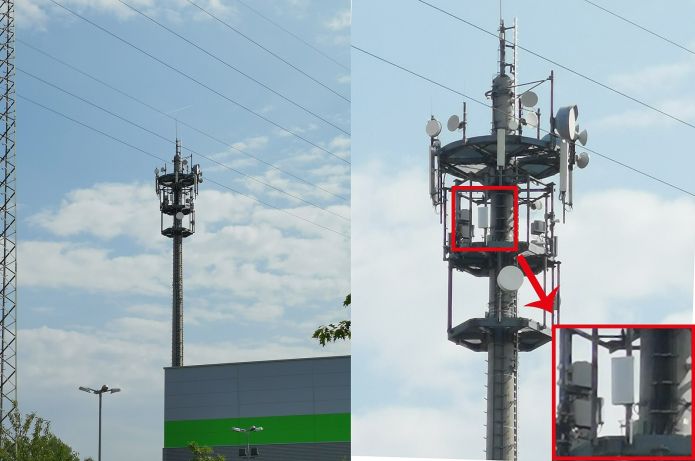
The materials that warn about the impact of 5G networks say that the relevant transmitters differ from the existing ones – they operate on different frequency bands, and the topology of the networks is also different, with a denser placement of cell stations.
The truth is that in Europe, 5G networks will mainly operate on the frequency bands 700 MHz, 3.4 to 3.8 GHz, and millimetre waves in the 24.25 to 27.5 GHz band. Frequencies in the 60 GHz band are also used. The spectrum for 5G networks is then divided into two areas – frequency range 1, the so-called old bands, which overlap and extend the existing 2G/3G/4G frequencies (these operate in the 450 MHz – 6 GHz band), and frequency range 2, which covers millimetre bands, i.e. frequencies from 26 GHz upwards. Bands in frequency range 1 are numbered from 1 to 255, while frequency range 2 uses the numbers 257 – 511. The ratio of the two spectra is supposed to be 1 : 90 (0.5 GHz : 45 GHz of spectrum), and millimetre waves will be decisive for the development of high-capacity internet.
Back to the “old” frequencies. The power levels used for 4G networks are the same as for the new fifth generation. We plan to use the same bands with the same power, but with higher spectral efficiency. Extending them by tens of megahertz is not significant at all from the point of view of calculating the overall intensity of the electromagnetic field. There is certainly no reason to fear fatal effects on the population, fauna or flora.
Incidentally, every band below 6 GHz was intensively used even before 5G. The 700 MHz band, for example, was until recently used to carry the television signal of some DVB-T multiplexes. Imagine the power of a 5G transmitter, with 30 dBm from its antenna. That is 1 W of output power into a 5G in-fill transmitter. Now compare it with the power of the Žižkov television transmitter, which has 74 dBm of effective radiated power. Does that figure seem similar to you? Oops, my mistake: it is 30,000 times higher. The output of the television tower is 30 kW!
For the 3.4–3.8 GHz band, we can find telecommunications uses going back decades; most recently it was WiMAX. Currently, some radio data technologies for fixed internet, most often 4G+, operate on this frequency. Here, too, there is no risk of physical effects on living organisms. This perhaps slightly complicated paragraph could be simplified to the conclusion that 5G networks are roughly as harmful as any other radio transmission – that is, not at all. At their core, this technology does not differ from the existing 4G / LTE in any negative effects. Opponents of 5G networks also argue that they increase electrosmog. That is a mistaken conclusion, as these frequency ranges were already used intensively before. A denser network of transmitters is indeed needed: for good-quality service delivery, the target objects must be visible, and precisely in order to comply with strict hygiene limits, base stations must be placed densely. A dense network will also be needed wherever there are many data-hungry clients on the network, because the load has to be distributed.
TIP: Read more on this topic in our article What is the difference between Wi-Fi standards?
But what about the effects of “over-waving” the space? Go outside into the sunshine, take off your T-shirt and expose yourself to the waves of sunlight for a few minutes. Do you feel the heat? You have just heated your body with a dose of thermal waves that you would not get even from several months of staying right next to a 5G transmitter. And that is without considering the body's ability to cool itself naturally. Moreover, the energy of a transmitter decreases with the square of the distance from it. So, very, very dramatically.
A definitive argument for the safety of 5G waves is also the position of the World Health Organization, which states that “despite extensive research, there is still no evidence to conclude that exposure to low-level electromagnetic fields is harmful to human health”. 5G networks therefore have no influence whatsoever on the spread of any diseases, including coronavirus infection.
Sources: WHO, Wikipedia, Denník N
Updated 15 March 2024